Let’s be real. Most people say “SEO” when they actually mean “I want this one page to rank higher for this one keyword and start bringing leads this month.”
That’s search engine positioning in a nutshell.
If SEO is the full gym routine, search engine positioning is walking in, grabbing the heaviest dumbbell, and training one muscle group until it shows up in the mirror.
And yes, it can work fast. Not magic-fast. But “this page moved from position 18 to 7 in a few weeks” fast, when the site already has a baseline of trust.
This guide is written the way we’d explain it to a client at The Node Blox (Sterling, VA, serving Northern Virginia and the DMV). It’s built to help you rank locally and to help you show up in the places that now matter just as much as blue links: featured snippets, People Also Ask, local pack, and even AI summaries.
What Is Search Engine Positioning?
Search engine positioning is the process of improving a specific page’s ranking for a specific keyword (or tight set of keyword variations) until it holds a strong spot on page one.
It’s not the same thing as “do SEO on the whole site.” It’s narrower.
Think:
- “Rank my service page for ‘kitchen remodeling Sterling VA’”
- “Get my blog post into the featured snippet for ‘how long does ceramic coating last’”
- “Move my landing page from position 14 to top 5 for ‘Facebook ad agency’”
Search engine positioning is focused, measurable, and usually tied to revenue.
Search Engine Positioning vs SEO: The Difference That Actually Matters
Here’s the simplest way to frame it:
SEO = building site-wide strength.
Search engine positioning = pushing one page up the SERP ladder.
SEO includes broad tasks like:
- technical fixes site-wide
- content strategy across many topics
- link building across multiple pages
- authority building and topical coverage
Search engine positioning focuses on:
- one page
- one primary keyword
- one SERP
- and the actions that move that page up, faster
Important reality check: search engine positioning works best when SEO groundwork exists. If your site is brand new, has no backlinks, and Google barely knows you, you can still do positioning, but it will feel like trying to win a race in flip-flops.
How Google Decides a Page’s Position (In Plain English)
Google’s ranking systems are complex, but for search engine positioning, you mainly influence these buckets:
1) Relevance and intent match
Does the page satisfy what the searcher wants right now?
2) Content clarity and structure
Can Google easily extract answers (snippets, PAA, AI summaries)?
3) Trust and authority signals
Is this site and page credible enough to deserve visibility?
4) Engagement signals that correlate with satisfaction
Does the page earn clicks and keep people from pogo-sticking back to results?
5) Technical performance
Does it load fast, work on mobile, and avoid UX problems?
6) Location signals (for local intent)
Are you clearly relevant to Sterling, VA, Northern Virginia, and the DMV where appropriate?
Search engine positioning is basically controlling as many of these as possible for one target page.
The “SERP Ladder” Method: How to Improve Search Engine Positioning Step-by-Step
If you want a clean process you can repeat, use this.
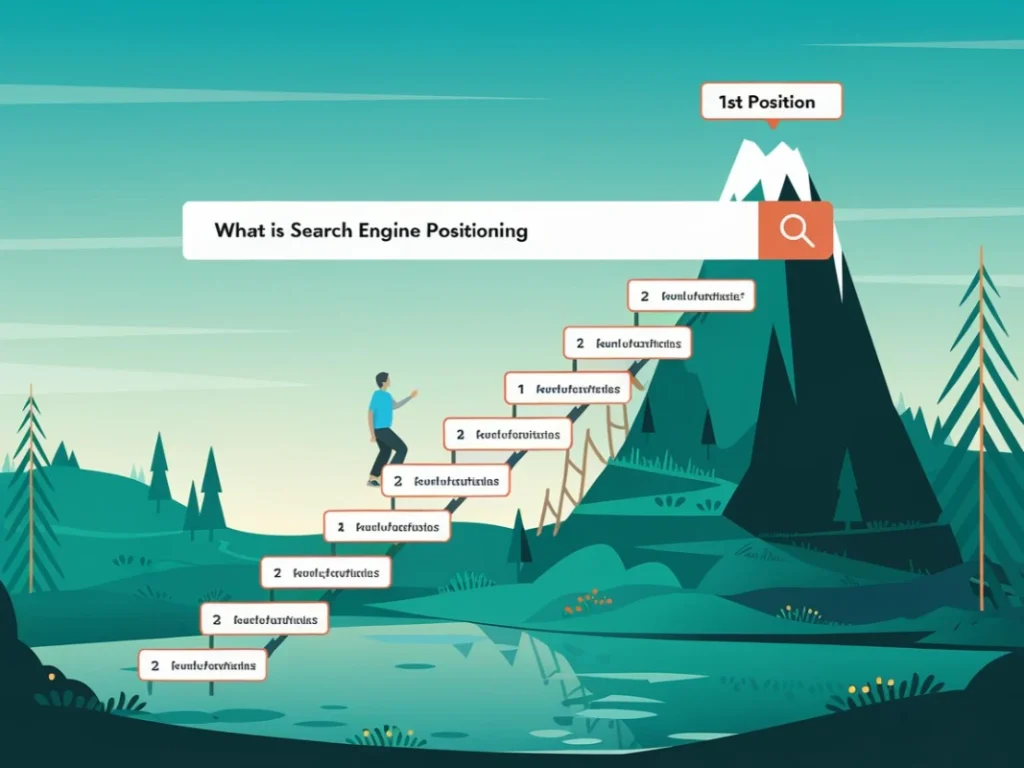
Step 1: Pick the page that can actually win
Start with pages that are either:
- already ranking in positions 8–30 (prime “push” zone), or
- a money page (service/landing page) that’s strategically important
If you’re a local business, the best targets are often:
- service pages
- location pages
- “best of” comparison pages
- pricing pages
- case study pages
Step 2: Confirm the real search intent behind “search engine positioning”
Search intent can look informational, but the SERP often reveals hidden intent like:
- people want a definition + examples
- people want a checklist
- people want tools and tracking methods
- people want “how to improve position” steps
To beat competitors, you don’t just match the intent. You satisfy it faster, clearer, and deeper.
Your page should answer:
- What is search engine positioning?
- How is search engine positioning different from SEO?
- How do I check my position?
- What steps increase search engine positioning quickly?
- How do SERP features affect positioning?
- What does this look like for local SEO?
Step 3: Engineer the on-page “Position Signals”
This is where most articles get lazy.
For search engine positioning, your page should include:
- a tight opening definition
- a quick “how it works” breakdown
- a step-by-step checklist
- a SERP features section (snippet, PAA, local pack)
- tracking guidance (Search Console + rank tracker)
- a refresh plan (so you don’t slide back)
You’re not just writing content. You’re building something Google can parse and users can trust.
Step 4: Re-optimize the page like you mean it
This is where rankings move.
URL
Keep it clean, readable, keyword-aligned.
Title tag
Make it click-worthy, not just keyword-stuffed.
H1
Include the primary keyword naturally: Search Engine Positioning
H2s and H3s
Use variations like:
- “Search engine positioning vs SEO”
- “How to improve search engine positioning”
- “How to check search engine positioning”
- “Search engine positioning best practices”
- “Search engine positioning for local businesses”
First 100 words
Mention search engine positioning early. Then explain it. Then promise a clear outcome.
Add “snippet blocks”
Create small sections designed to be extracted:
- definitions (40–60 words)
- short lists (5–8 bullets)
- quick steps
This increases your odds of winning featured snippets and AI summaries.
Step 5: Build an internal link funnel to the target page
Internal links are one of the cleanest, safest levers for search engine positioning.
Do this:
- link to the target page from your highest-authority pages
- link from related blog posts using descriptive anchors
- add “related services” sections that naturally point to the target page
Avoid spammy anchors like repeating the exact keyword 20 times.
Use natural anchors like:
- “improving rankings”
- “on-page SEO checklist”
- “local SEO strategy”
- “technical SEO audit”
Internal link suggestions (The Node Blox style):
- From your Digital Marketing page → to your SEO Strategy page
- From your SEO Strategy page → to your Technical SEO page
- From your Web Development page → to your SEO Services page
- From your Blog “SEO Tips” → to your “Local SEO Sterling VA” page
Step 6: Improve CTR without lying
If your page is ranking but not climbing, CTR is often the choke point.
Ways to lift CTR:
- Put the benefit first in the title
- Add specificity (numbers, time frames, “step-by-step”)
- Use a clean meta description that matches intent
- Add “2026” only if it’s truly updated and relevant
Example title improvements:
- “Search Engine Positioning: 9 Steps to Move a Page Up Fast”
- “Search Engine Positioning vs SEO: What Actually Moves Rankings”
CTR is a positioning lever because higher clicks (when aligned with satisfaction) tend to reinforce that your result is the right answer.
Step 7: Reduce pogo-sticking (the silent ranking killer)
A page can get clicks and still lose position if users bounce back to Google instantly.
Fix that by:
- answering the question quickly near the top
- adding clear subheadings so users can jump to what they want
- using short paragraphs and punchy formatting
- adding real examples and next-step actions
Make your content feel like, “Finally, someone explained this without wasting my time.”
Step 8: Win SERP features to dominate positioning
Here’s the truth most people miss:
You can “win” a keyword without being #1 if you dominate the SERP features.
Target these:
Featured Snippet
Add a definition block and a quick step list.
People Also Ask
Add FAQ-style H3s with 2–3 sentence answers.
Image Pack
Add a simple diagram image and optimize the alt text.
Local Pack (when intent is local)
Make sure the page reinforces:
- city and service relevance
- consistent NAP signals site-wide
- strong local credibility signals
For Sterling and Northern Virginia businesses, this is where you combine organic positioning with local SEO so you show up twice on the same results page.
Step 9: Strengthen trust signals on the page
For search engine positioning, trust isn’t just backlinks. It’s what users can see.
Add:
- author name or “reviewed by” attribution
- proof points (experience, outcomes, process)
- testimonials or client results when appropriate
- clear business location signals for local relevance
If you’re The Node Blox in Sterling, VA, make that obvious:
- Sterling, VA mention
- Northern Virginia and DMV mention where natural
- services tied to local businesses (law firms, contractors, clinics, ecommerce, etc.)
Step 10: Refresh the page on a schedule
Positioning is not “set and forget.”
A practical refresh rhythm:
- every 60–90 days for competitive keywords
- every 90–120 days for stable keywords
Refresh means:
- add new examples
- tighten sections that feel fluffy
- update screenshots and tools
- improve internal links based on new content published
This is how you maintain search engine positioning after you earn it.
How to Track Search Engine Positioning the Right Way

Use two layers:
Layer 1: Google Search Console
Track:
- clicks
- impressions
- CTR
- average position (use it as a trend, not a single truth)
Layer 2: Rank tracking
Use a rank tracker to monitor:
- your keyword position by location
- SERP feature presence
- competitors moving up or down
For local businesses, track location-specific results. Sterling, VA rankings can look different than DC or Arlington.
Search Engine Positioning Best Practices (Quick Checklist)
If you just want the “do this now” list:
- Choose a page in the 8–30 ranking zone
- Confirm intent and SERP features
- Rewrite title and meta for clicks
- Add a definition block + step list
- Improve internal linking to the page
- Add FAQs that mirror PAA questions
- Improve page speed and mobile UX
- Add proof, examples, and trust signals
- Build a few quality links to the page (when realistic)
- Refresh the page every 60–90 days
That’s search engine positioning in real life.
Search Engine Positioning for Local Businesses in Sterling, VA (and the DMV)
If you want to rank locally, you need two things working together:
- a page that matches the query and satisfies intent
- strong local relevance signals
What local relevance looks like on-page:
- mention Sterling, VA naturally (not spammy)
- mention nearby areas only where it makes sense (Reston, Herndon, Ashburn, Fairfax, Arlington, DC)
- include service area language
- include “who we help” with local business types
- include trust signals tied to your region (projects, results, community presence)
This is where The Node Blox typically wins positioning for local clients: we combine page-level positioning with local authority building so Google has multiple reasons to show the business.
Common Mistakes That Tank Search Engine Positioning
Mistake 1: “Keyword density” becomes keyword stuffing
Aim for natural usage. Don’t repeat “search engine positioning” every other sentence like you’re trying to hypnotize Google.
Mistake 2: You optimize the page but ignore internal links
If your own site doesn’t treat the page as important, why should Google?
Mistake 3: You don’t match SERP format
If the SERP is full of step-by-step guides, and your page is a vague essay, you’re not competing.
Mistake 4: You never refresh
Competitors update. SERPs evolve. You slide.
Mistake 5: You ignore conversions
Ranking is nice. Leads are nicer.
Every positioning page should have a clear next step:
- request a quote
- schedule a call
- get an audit
- download a checklist
- request a consultation
FAQ: Search Engine Positioning
What is search engine positioning?
Search engine positioning is the process of improving a specific page’s ranking for a specific keyword so it appears higher in organic search results.
How is search engine positioning different from SEO?
SEO improves the whole website over time. Search engine positioning focuses on pushing one page higher for one keyword faster.
How do I check my search engine position?
Use Google Search Console for average position trends and a rank tracker for daily keyword position tracking, including local variations.
How long does search engine positioning take?
If your site already has trust and the page is close to page one, improvements can happen in weeks. For new sites, it takes longer.
What helps search engine positioning the most?
Clear intent match, strong on-page structure, internal linking, CTR improvements, trust signals, and ongoing content refreshes.
If You Want Faster Search Engine Positioning, Here’s the Straight Advice
Pick one page. Pick one keyword. Then do the work that actually moves the needle:
- tighten the intent match
- structure content for extraction
- build internal links like you’re guiding Google
- improve CTR and satisfaction
- refresh before you drop
That’s how pages climb.
And if you want a team to do this properly, The Node Blox (Sterling, VA) builds positioning campaigns that don’t just chase rankings. We build pages that earn clicks, keep attention, and turn traffic into calls.
If you want, paste your target page URL (or the draft content), and I’ll rewrite it into a positioning-ready version with the exact headings, snippet blocks, and internal link placements that fit your site structure. See us on LinkedIn or Twitter (X).