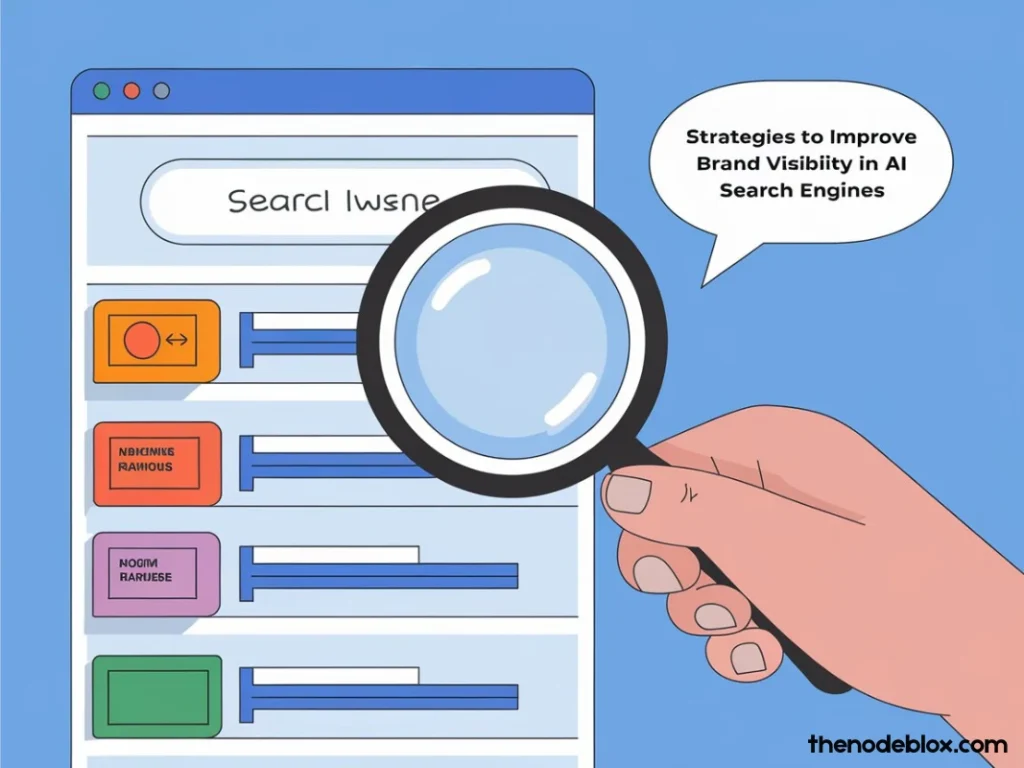
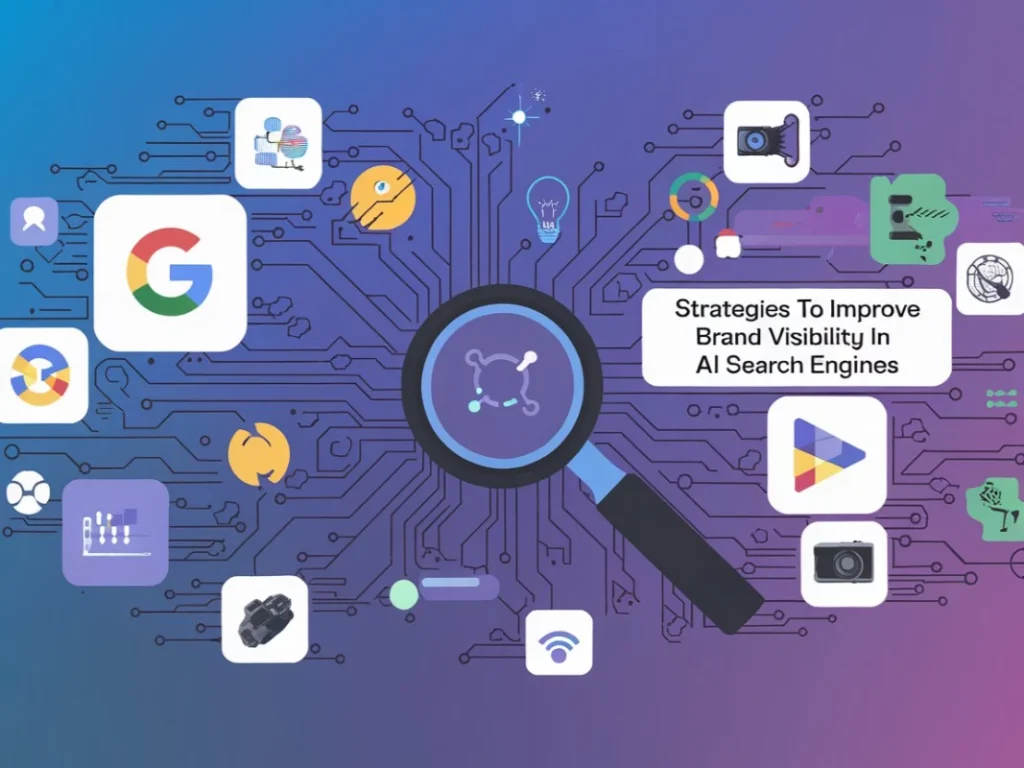
Let’s be honest: “ranking #1” feels great… until Google shows an AI Overview that answers the question without sending clicks, and ChatGPT summarizes the topic using everyone except you. In this guide you’ll get info about Strategies to improve Brand Visibility in AI Search Engines.
That’s the new game.
Brand visibility in AI search engines is about becoming a trusted source that answer engines can safely quote, summarize, and cite. It’s not only “SEO” anymore, it’s SEO plus credibility, entity signals, and content that’s easy for machines to extract without guessing.
And yes, you can absolutely beat competitors who write generic, checklist-only content. Most of them stop at “use EEAT” and “add schema” then call it a day. We’re going further: a real execution plan built for 2026, designed to increase AI-referred traffic, citations, and qualified leads for The Node Blox (Sterling, VA + the DMV: Northern Virginia, DC, Maryland).
What brand visibility in AI search engines actually means
Answer-first (keep this tight): Brand visibility in AI search engines means your brand shows up inside AI-generated answers (AI Overviews, ChatGPT, Gemini, Perplexity) as a mention, recommendation, or citation. Instead of competing for ten blue links, you’re competing to be considered reliable enough to quote.
AI systems typically follow a pattern that looks like: discover → understand → trust → cite. If you’re missing any one of those steps, you don’t get picked.
Traditional SEO vs AI visibility (why your old playbook feels weaker)
Traditional SEO is largely about:
- keyword targeting
- content depth + relevance
- backlinks
- technical SEO
- CTR and engagement improving rankings over time
AI visibility adds a layer:
- entity clarity (who you are, what you do, where you operate)
- extractability (clean structure, “answer chunks,” definitions, lists)
- trust signals beyond links (reviews, consistent citations, PR mentions, expert authorship)
- machine-readability (schema, clean HTML, accessible pages)
- indexing breadth (not only Google; Bing matters a lot for several AI experiences)
So yes, you still need strong SEO… but now you need to be the easiest credible source to use.
The 10 strategies that actually move the needle in 2026
1) Write “answer chunks” that AI can lift without rewriting
Answer-first: AI prefers content that answers a question clearly in 40–60 words, immediately under the heading. When your page makes the answer obvious, the model can quote you with confidence.
Do this:
- Under every H2/H3, start with a short direct answer (2–4 sentences).
- Then expand with details, steps, examples, and edge cases.
- Use bullets and numbered lists often (they extract cleanly).
- Add a quick definition early in the article.
Example format:
- H2: “How do you improve brand visibility in AI search engines?”
- 50-word answer
- bullets + steps
- short FAQ
This alone will outperform a lot of competitors who write long paragraphs that say nothing until paragraph #6.
2) Build entity signals so AI understands your brand as a “known thing”
Answer-first: AI systems don’t just read pages. They build a mental model of entities: brands, people, locations, services. If your entity is fuzzy, you get ignored.
Do this on The Node Blox site:
- Create a consistent “boilerplate” description used across:
- homepage
- About page
- author bio
- service pages
- footer
- Include:
- brand name
- what you do (digital marketing, SEO, paid ads, web/app development)
- who you help (local businesses, service brands, B2B, etc.)
- service area (Sterling, VA; Northern Virginia; Washington DC; Maryland)
This consistency helps AI confidently connect “The Node Blox” with the topics you want to own.
3) Double down on E-E-A-T, but make it provable
Answer-first: Saying “we’re experts” doesn’t count. AI and search systems favor content that shows real experience, has accountable authorship, and is supported by reputable references.
Do this:
- Put a real author on each article (name + role + short credentials).
- Add a “Last updated” date and actually update it.
- Include:
- real screenshots (blur sensitive data)
- real checklists you use with clients
- mini case examples (even anonymized)
- “what we’d do if this happened” scenarios
Make it obvious the content came from practitioners, not a content spinner.
4) Use schema that strengthens “who said what”
Structured data helps machines interpret your content and your brand. Google documents that it uses crawlers and structured signals for how it fetches and processes content, and it also provides a dedicated token (Google-Extended) publishers can use to control AI training usage.
Minimum schema stack (JSON-LD):
- Organization
- LocalBusiness (if applicable for local signals)
- WebSite
- WebPage
- Article
- Person (author)
- FAQPage (where relevant)
- Review / AggregateRating (only if legitimate)
Pro tip: Add an author box and connect the author entity to the Organization.
5) Don’t block the bots you want to cite you
Answer-first: If AI crawlers can’t access your content, they can’t cite it. Sounds obvious. People still accidentally block what matters.
OpenAI provides documentation about its crawlers and how to manage access.
Google documents its crawler ecosystem and also publishes guidance around AI-related crawl controls (including Google-Extended).
What to check (quick checklist):
- robots.txt isn’t blocking key sections (blogs/resources)
- noindex isn’t applied by mistake
- canonical tags aren’t pointing to the wrong URL
- pages aren’t trapped behind heavy JS rendering
- important pages are in your XML sitemap
If you want AI visibility, your best content needs to be accessible and indexable.
6) Win “citation surfaces”: PR, podcasts, niche blogs, and community platforms
Answer-first: AI models trust information that’s repeated across reputable sources. One lonely blog post on your site is weaker than ten credible mentions across the web.
What to do (realistic + repeatable):
- Publish 1 proprietary mini-study per quarter:
- “DMV service businesses: lead cost benchmarks for Google Ads vs Meta”
- “What actually improved conversion rates after AI Overviews (client data)”
- Pitch it to:
- industry blogs
- newsletters
- podcasts
- Repurpose into:
- LinkedIn posts
- Reddit threads (value-first, not spam)
- Quora answers
That’s how you build a citation flywheel: your site becomes the “source,” other sites repeat it, AI notices the repetition.
Also Read: AI Max for Search Campaigns Explained (2026): What Changes and What to Lock Down Before You Run It
7) Create “definitive pages” that are hard to replace
Competitors often write broad posts that could be swapped with any other blog on the internet.
Instead, publish pages that feel like:
- a standard
- a reference
- a checklist people save
Examples for The Node Blox:
- “AI Overviews Citation Checklist (2026)”
- “Local Business Entity SEO: Sterling VA + DMV Blueprint”
- “Google Ads Conversion Tracking Checklist (GA4 + GTM + Enhanced Conversions)”
- “Meta Ads Offer Testing Framework (50 tests library)”
AI systems love pages that look like references.
8) Optimize for natural language questions (because that’s how prompts work)
Answer-first: People don’t prompt AI like they type into Google. They ask full questions. Your headings should match that.
Use headings like:
- “How do I get my business cited in AI Overviews?”
- “What makes AI trust a source enough to cite it?”
- “What schema helps AI understand my brand?”
- “How do I measure AI visibility?”
Then answer directly under each heading
9) Make reviews and reputation part of your AI SEO
If you’re pushing local visibility (Sterling, VA + DMV), reviews are not optional. They feed trust signals across platforms.
Do this:
- Build a review capture flow (email/SMS after delivery)
- Add testimonials with specifics (problem → result)
- Mark up reviews with schema (only truthful, no fake stuff)
This supports both local SEO and AI trust-building.
10) Measure AI visibility like a grown-up (not vibes)
Answer-first: If you can’t measure it, you can’t improve it. AI visibility requires tracking citations, mentions, and inclusion across prompts, not just rankings.
What to track monthly:
- AI Overview appearances for target queries (manual spot checks + recorded screenshots)
- referral traffic from known AI sources (where available)
- branded search lift (“The Node Blox” queries rising)
- citations/mentions growth (PR + community)
- engagement on “definitive pages” (time on page, scroll depth)
- conversions from those pages (form fills, calls, bookings)
Simple system: create a “prompt set” (20–50 prompts) and test monthly:
- “Best AI SEO agency in Sterling VA”
- “How to get cited in AI Overviews”
- “Agency that can implement schema and tracking correctly”
Track whether you’re mentioned, where, and why.
The Node Blox “AI Visibility Game Plan” (the part competitors don’t give you)
Here’s a clean rollout you can execute without chaos:
Week 1: Fix foundations
- schema baseline
- sitemap + indexing
- internal linking
- author bios + last updated
- GBP consistency (services + categories + areas)
Weeks 2–3: Publish 2 definitive assets
- 1 checklist post (high extractability)
- 1 local authority post (DMV-focused)
Weeks 4–6: Build citations
- 10 community contributions (value-first)
- 3 guest mentions / interviews
- 1 mini dataset post + outreach
Ongoing: Refresh + expand
- update every 30–60 days
- expand FAQs
- add new examples + screenshots
- keep building external mentions
This is how you create compounding AI visibility.
FAQs
How do you get cited by AI Overviews?
Publish clear answer-first content, strengthen EEAT with real authors and proof, add schema, earn third-party mentions, and keep pages crawlable and updated.
How do you get featured in AI Overviews?
Aim for extractable sections (definitions, bullets, short direct answers), align tightly to user intent, and build authority signals through citations, reviews, and reputable mentions.
How to get cited by AI systems like ChatGPT and Gemini?
Make your brand an entity (consistent brand info + schema), create definitive resources, and expand off-site validation through PR, community platforms, and credible references. Also ensure AI crawlers can access your content.
What are the most cited domains in AI Overviews?
It varies by query, but AI Overviews commonly cite sources that are highly trusted, clearly structured, and repeatedly referenced across the web (official docs, authoritative publishers, strong niche sites).
Synopsis
AI search isn’t the future. It’s already here, and it’s ruthless about one thing: trust. If your brand isn’t getting cited, you’re basically invisible to the fastest-growing way people discover answers.
If you want The Node Blox to turn your site into a citation magnet (AI Overviews, ChatGPT, Gemini), we’ll audit your AI visibility, fix the technical blockers, build your entity signals, and publish the kind of content that AI can confidently pull into answers. See us on Instagram & LinkedIn.
Ready to be the source AI uses instead of the site it skips?
Book an AI Visibility Audit with The Node Blox and let’s build your citation flywheel.