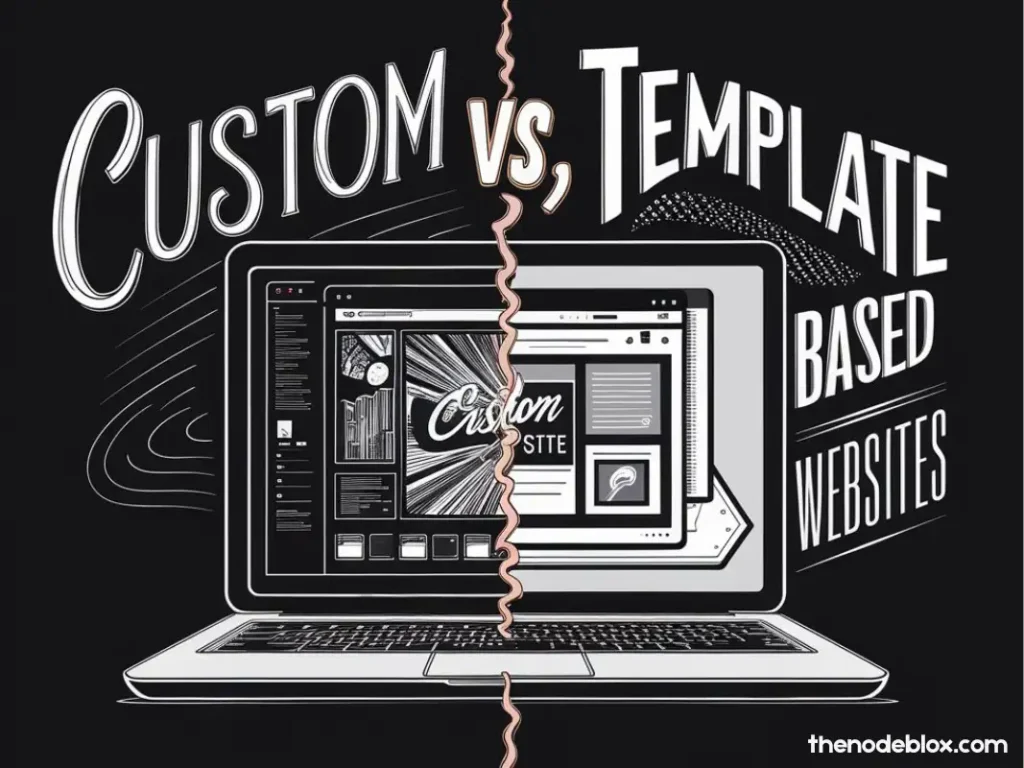
Custom vs Template Based Websites is one of those arguments that never dies. Every agency has an opinion, every platform says it is the answer, and you are stuck in the middle just trying to get a site that brings in real business.
In this guide, I am going to walk you through Custom vs Template Based Websites in plain language, with real scenarios, so you can decide what makes sense for your stage, budget, and growth plans.
All of this is written with The Node Blox in mind as your digital partner for digital marketing, web development, app development, SEO strategy, and social media marketing. You can use this as your blueprint before you touch a single theme or sign a custom dev contract.
What Does Custom vs Template Based Websites Actually Mean?
Before we talk about SEO, ROI, and conversions, let us get the wording right.
Template based website
A template based website is built on an existing layout or theme. Think:
- WordPress themes
- Wix or Squarespace templates
- Webflow templates
You start with a prebuilt design. You change colors, fonts, images, text, maybe some layout blocks. You rarely touch the core code. It is faster and cheaper to launch.
Custom website
A custom website is designed and developed around your brand and your goals. Layout, user journeys, code, structure, and integrations are built to fit:
- Your offers
- Your brand identity
- Your sales process
- Your digital marketing strategy
Custom does not always mean 100 percent from scratch with no framework. It usually means you are not forcing your business to fit inside an off the shelf theme. The site is shaped around you, not the other way around.
That is the heart of Custom vs Template Based Websites. It is not only about design. It is about control, performance, and long term flexibility.
Custom vs Template Based Websites: Custom Site Breakdown
Let us start with the custom side of Custom vs Template Based Websites.
What is a custom website in practice?
When we build a custom site at The Node Blox, the process usually includes:
- Strategy: goals, offers, audience, positioning
- Site architecture: pages, navigation, funnels
- UX and UI: wireframes, layouts, visual direction
- Development: clean code, scalable structure
- SEO setup: technical foundations, URL structure, on page SEO
- Integrations: CRM, booking, payments, automations
- Launch and optimization
You are not picking a theme and filling in blanks. You are designing the experience around how you want people to find you, move through the site, and contact you.
Pros of custom websites
- Brand identity is 100 percent you
Your site does not look like the other five businesses in Sterling using the same theme. Good for trust, good for pricing power. - Better long term SEO potential
Clean code, logical structure, and a site built around content and keyword strategy makes it easier to rank. You have more control over performance, technical SEO, and future content. - Built around conversions
You can design custom funnels, landing pages, and forms that match your sales process. Perfect for local service businesses, SaaS, and serious ecommerce. - Scales with you
When you add new services, locations, or products, the system can handle it. You are not fighting theme limitations every time you grow. - Deeper integrations
Need advanced booking, custom app features, or a tight connection with your CRM and marketing automations. Custom web development gives you room to move.
Cons of custom websites
- Higher upfront cost
You are paying for strategy, design, and development. It is an investment, not a quick patch. - Longer timelines
Proper custom builds take weeks or months, not days. If you need a basic site live by Friday, this is not it. - Requires a real partner
You need a team that understands digital marketing, web development, SEO strategy, and conversion design. If you just hire a cheap coder, you will not get the real value of custom.
Custom vs Template Based Websites: Template Site Breakdown
Now the other side of Custom vs Template Based Websites.
What is a template based website in practice?
A template based site starts from a predesigned layout. You:
- Pick a theme that looks close to what you want
- Change logo, colors, and content
- Adjust some layout blocks
- Install a few plugins or apps
If your needs are simple, you can get a site live quickly, especially with platforms like Wix, Squarespace, or starter WordPress themes.
Pros of template based websites
- Lower cost to launch
You can get online with a small budget. Good for testing an idea or basic presence. - Speed
You can launch in days, sometimes hours, if you keep things simple. - No deep technical skills required
Many templates are drag and drop. You can manage content yourself after a basic handoff. - Good enough for simple projects
If you only need a digital brochure with a phone number and some photos, templates can work.
Cons of template based websites
This is where most people get burned.
- You look like everyone else
If five other businesses in your niche use the same theme, you instantly look generic. In competitive markets like the DMV, that hurts. - Design and layout limitations
At some point, the template fights you. You want a certain layout, but the theme was never built for it. - Code bloat and performance issues
Many template based websites load a lot of unnecessary CSS and scripts. Slower load times hurt both SEO and conversions. - SEO control is limited
You can still do decent on page SEO, but you often have less control over URL structure, performance, and technical tuning. - Scalability is painful
Adding complex features or scaling across multiple locations can turn into a mess of plugins and hacks.
Custom vs Template Based Websites: Side by Side Comparison
Here is how Custom vs Template Based Websites usually plays out:
| Factor | Template Based Website | Custom Website |
|---|---|---|
| Initial cost | Low | Medium to high |
| Time to launch | Very fast | Slower, planned |
| Brand uniqueness | Limited | High |
| SEO flexibility | Basic | High |
| Performance potential | Often average | Can be excellent |
| Scalability | Limited by theme | Built to scale |
| Control over user journey | Template driven | Strategy driven |
| Integrations | Plugin dependent | Built around your stack |
| Best for | Simple sites, early stage, tight budgets | Growth focused, competitive markets, serious brands |
You can already see why the real answer to Custom vs Template Based Websites is not one size fits all. It depends where you are and where you want to go.
Custom vs Template Based Websites For Different Business Types
Here is where your competitors fall short. They talk theory. Let us talk about actual businesses in Sterling and the wider DMV.
Local service businesses in Northern Virginia
Think remodelers, limo services, landscaping, auto detailing, dentists, law firms.
- If you just started and need a basic online presence:
A well chosen template can be fine for a short while. You still need good content, local SEO, and clean contact forms. - Once you start running SEO campaigns, Google Ads, or social media marketing:
Template restrictions show up fast. You want specific landing pages, better speed, and custom funnels. This is where a custom website built around SEO strategy often pays for itself.
For local service businesses, Custom vs Template Based Websites comes down to this:
If you rely on your website to generate leads and not just exist, you eventually outgrow templates.
Ecommerce and product based brands
Templates can get you a quick online store, but:
- Performance and UX become critical as traffic grows
- You may need custom filtering, product bundles, upsells, advanced search
Custom development gives you:
- Better product discovery
- Faster checkout
- More options for A/B testing and optimization
For ecommerce, custom wins hard once you are past the hobby stage.
B2B, SaaS, and high ticket services
If you are selling complex solutions, consulting, or software, your website is pure positioning and trust.
In this space, Custom vs Template Based Websites is almost unfair. Templates are not built for deep storytelling, custom flows, or interactive content that builds authority.
A custom website here lets you:
- Explain your value in a structured way
- Build tailored landing pages for each vertical or region
- Integrate content marketing, lead magnets, and nurture flows
If your B2B or SaaS brand is based in the DMV and you want to compete nationally, custom is almost mandatory.
Cost and ROI: The Truth Behind Custom vs Template Based Websites
Let us make it less abstract.
Template based website cost scenario
- Theme or template: low cost or even free
- Setup by a freelancer or small agency: relatively affordable
- Launch: fast
Short term, this looks great. But long term:
- You add plugins to fix missing features
- Site slows down
- Developer hours go into hacking around theme limitations
- You eventually need a redesign or rebuild
That cheap start can cost more in ongoing patchwork and lost opportunities.
Custom website cost scenario
- Strategy, design, and build with a team like The Node Blox is a real investment
- Launch takes longer
- You get a structure that matches your digital marketing plan, SEO strategy, and future offers
Where custom wins is long term math.
If a custom website helps you:
- Improve conversion rate from 2 percent to 3.5 percent
- Capture more leads from organic search
- Support higher pricing through better brand presentation
You recover the extra investment through increased revenue and lower ongoing headaches.
Custom vs Template Based Websites is really short term savings vs long term growth.

Custom vs Template Based Websites For SEO, Performance, And Digital Marketing
Your competitors mention SEO, but they barely scratch the surface.
Why custom is usually better for SEO
- Clean, purposeful code
- URL structures built around keyword strategy
- Better control of site architecture for topic clusters and content hubs
- Easier integration of technical SEO improvements over time
When The Node Blox designs a custom site, we build it hand in hand with:
- Keyword research
- Content structure
- Future blog plan
- Local SEO targeting for Sterling, Northern Virginia, and the DMV
You do not bolt SEO on later. It is baked in.
Template sites and SEO
Can a template based website rank. Yes, especially for low to medium competition terms.
But you fight problems like:
- Bloated code from features you do not use
- Limited control over some structural elements
- Plugin conflicts that slow down the site
In competitive markets, performance and structure matter. That is why Custom vs Template Based Websites is such a big decision for SEO focused businesses.
7 Questions To Decide Custom vs Template Based Websites
If you are still torn, walk through this list:
- How fast do you need to launch
If you need a site live this week and perfection is not the goal, template. - How important is Google traffic in the next 12 to 24 months
If organic search and long term SEO are core to your plan, lean toward custom. - How competitive is your market
Competing in Sterling, Fairfax, Arlington, or DC for high intent local keywords is not the same as being the only bakery in a small town. - Do you need advanced integrations
If you rely on CRM automations, custom quoting, or app style features, custom will hurt less over time. - Do you plan to expand locations or services
Multi location SEO and complex service structures are easier with a custom architecture. - What is your realistic budget range
If your entire marketing budget is tiny, start with a template, then plan for a custom upgrade once revenue increases. - Do you want your brand to feel premium and differentiated
If your positioning, pricing, and brand all aim high, a generic theme undercuts the whole strategy.
Answer these honestly and you will know where you stand in the Custom vs Template Based Websites decision.
FAQs About Custom vs Template Based Websites
Is a custom website always better than a template based website?
No. Custom vs Template Based Websites is not a fixed hierarchy. If you are early, on a tight budget, and just need a clean presence, a good template is fine. Custom shines when SEO, performance, and growth are serious priorities.
Are template based websites bad for SEO?
Not automatically. You can still rank with a template based website, especially in low competition niches. The problem shows up with bloated code, slow load times, and limited structural control as you scale.
Can I start on a template and move to custom later?
Yes, and it is often a smart path. Many clients start on templates, then work with The Node Blox to plan a custom rebuild once they understand their offers, audience, and content better. That way the custom site is built from real data, not guesses.
How do I know if custom is worth the investment?
If your website is central to:
- Lead generation
- Sales
- Brand positioning
and you are competing in strong markets across Sterling, Northern Virginia, and the wider DMV, custom usually pays off in higher conversions and more efficient digital marketing spend.
Final word: What should you do next?
If you are reading this because you are stuck between Custom vs Template Based Websites, here is the simplest move:
- Be honest about your budget and timeline.
- Decide how critical SEO and digital marketing are for your growth.
- Get a professional, unbiased look at your situation.
At The Node Blox, we help businesses in Sterling VA, Northern Virginia, and across the US make this decision with real strategy behind it, not guesswork. See us on LinkedIn & Instagram.
Call (202) 400-0428 or request your free estimate today.
Explore SEO Service and Web Development Service.
You do not need to be a developer, a designer, or an SEO expert. That is our job. Your job is to be clear about your goals. Then we can build, or upgrade, the website that actually supports them.