Progressive Web Apps (PWAs): When and Why to Use Them is no longer a developer-only conversation. It’s a growth decision.
If you run a business in Sterling, VA, Northern Virginia, Washington DC, or anywhere competitive, you’ve probably asked:
- Do I need a mobile app?
- Is a responsive website enough?
- Is there a middle ground that’s faster and cheaper?
That “middle ground” is a Progressive Web App.
But here’s the truth:
PWAs are powerful when used in the right scenario.
They are a waste of time when chosen for the wrong reason.
Let’s break it down clearly, practically, and strategically so you can decide whether a PWA fits your business model.
And if you’re serious about performance, SEO strategy, digital marketing, and scalable web development, this guide will give you the blueprint.
What Are Progressive Web Apps (PWAs)?
Direct Answer:
A Progressive Web App (PWA) is a website that behaves like a mobile app, offering fast loading, offline functionality, push notifications, and installability without requiring users to download it from an app store.
PWAs use modern web technologies like:
- Service workers
- Web app manifests
- Caching strategies
- Responsive frameworks
- Secure HTTPS protocols
The result?
A web experience that feels like an app.
No app store friction.
No heavy installation.
No 6-month approval process.
Why Progressive Web Apps (PWAs) Matter in 2026
Consumer behavior has changed.
Users expect:
- Instant loading
- Smooth navigation
- No lag
- Offline access
- App-like performance
If your site takes 4 seconds to load, you’re losing visitors. Period.
Google’s Core Web Vitals make this even more critical. Performance affects:
- Rankings
- Bounce rate
- Conversions
- AI visibility
- Engagement
A properly built PWA improves:
- Load speed
- User retention
- Session duration
- Repeat visits
- Mobile SEO signals
That’s not theory. That’s measurable performance.
Progressive Web Apps (PWAs): When to Use Them
Let’s get specific.
1. When You Want App-Level Performance Without App Store Costs
Native app development can cost:
- $25,000–$150,000+
- Ongoing updates
- App store commissions
- Platform restrictions
If your business needs mobile engagement but not full native hardware integration, a PWA is often the smarter investment.
For many DMV-based service businesses, startups, and ecommerce brands, a PWA delivers 80–90% of the benefit at a fraction of the cost.
2. When Speed Is Critical for Conversions
Progressive Web Apps (PWAs) are built for speed.
They cache assets locally, meaning:
- Returning visitors load instantly
- Pages feel fluid
- Checkout flows are smoother
- Repeat engagement improves
For ecommerce businesses, speed directly impacts revenue.
For local businesses in Sterling, Fairfax, Arlington, and DC, faster mobile performance improves:
- Local search rankings
- Map pack engagement
- Contact form completions
- Click-to-call conversions
3. When Your Audience Is Mobile-First
If 70%+ of your traffic is mobile (which it likely is), your website is already behaving like an app — just slower.
A PWA gives users:
- Add-to-home-screen functionality
- Push notifications
- Full-screen experience
- Native-style transitions
Without app downloads.
For digital marketing campaigns running Google Ads or social media marketing funnels, this dramatically improves landing page experience scores.
[Internal link: Google Ads Management]
[Internal link: Social Media Marketing]
4. When Offline Access Improves User Experience
PWAs allow partial offline functionality.
Examples:
- Ecommerce product browsing
- Saved blog articles
- Previously loaded dashboards
- Booking pages
This is particularly powerful for:
- Field service companies
- Real estate platforms
- Education platforms
- Event-based businesses
5. When SEO Matters More Than App Store Rankings
Native apps don’t rank in Google search results the same way websites do.
PWAs do.
That means:
- Organic traffic growth
- AI Overview visibility
- AI citation potential
- Featured snippet opportunities
- Local search optimization
For businesses focused on SEO strategy and AI search visibility, PWAs maintain search discoverability.
That’s a major competitive advantage.
When NOT to Use Progressive Web Apps (PWAs)
PWAs are powerful but not universal.
Avoid PWAs If:
- You need deep hardware integration (Bluetooth, complex AR, heavy device sensors)
- You require high-performance gaming
- You rely heavily on App Store distribution visibility
- You need advanced background processing
In those cases, native app development is better.
Technical Advantages of Progressive Web Apps (PWAs)
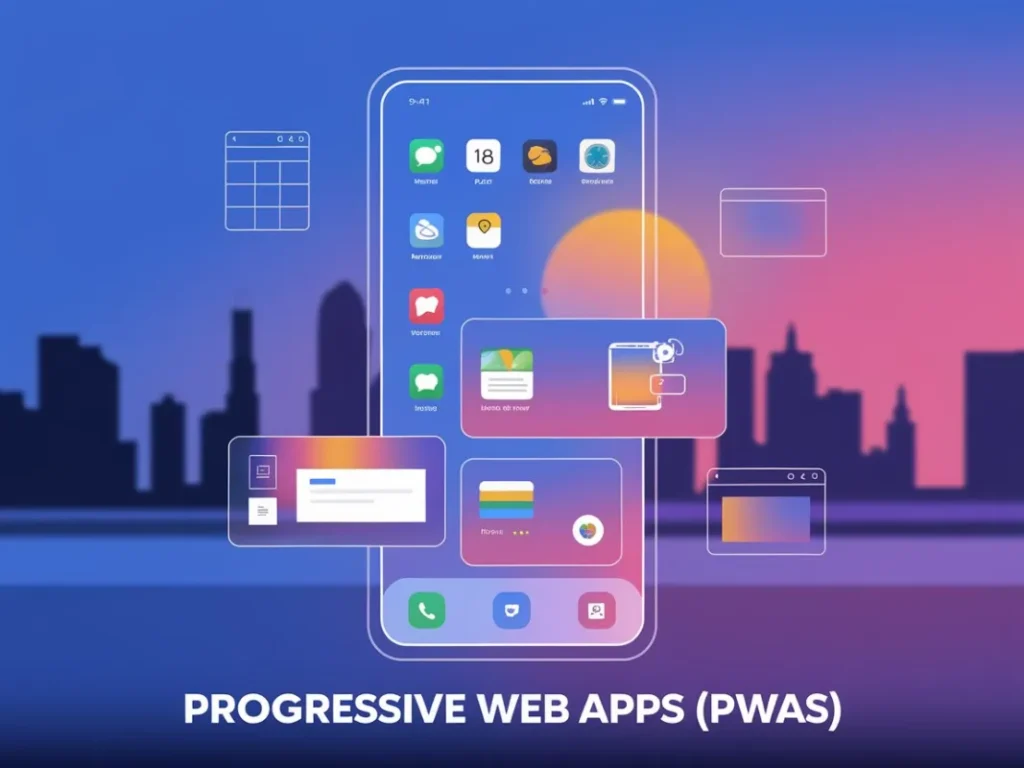
Let’s go deeper.
1. Service Workers (The Engine Behind PWAs)
Service workers:
- Cache resources
- Enable offline support
- Manage background sync
- Handle push notifications
This allows lightning-fast performance after the first visit.
2. Web App Manifest
The manifest controls:
- App name
- Icons
- Splash screen
- Display mode
- Theme colors
This makes installation seamless.
3. HTTPS Security
PWAs require HTTPS.
This ensures:
- Secure data transmission
- Trust signals
- Better SEO
- Compliance standards
Security improves user trust and conversion rates.
Progressive Web Apps (PWAs) and SEO
Here’s where most competitor articles fall short.
They mention performance.
They rarely explain the SEO implications.
PWAs improve:
- Core Web Vitals
- Page speed
- Crawlability
- User engagement signals
- Time on site
Google considers behavioral signals indirectly through ranking factors.
AI search engines also prefer:
- Structured content
- Fast loading
- Accessible HTML
- Clear entity definitions
When combined with structured data (Schema.org), a PWA strengthens AI visibility.
Progressive Web Apps (PWAs) and Digital Marketing
If you’re running paid traffic:
- Google Ads
- Meta Ads
- LinkedIn campaigns
Landing page experience affects cost per click.
A faster, smoother PWA reduces:
- Bounce rates
- Ad spend waste
- Form abandonment
For performance-driven marketing, that matters.
PWAs also enable:
- Push notifications for abandoned carts
- Re-engagement campaigns
- Flash sale alerts
- Event reminders
That’s retention without extra ad spend.
Local SEO Benefits of Progressive Web Apps (PWAs)
For businesses in:
- Sterling, VA
- Fairfax County
- Loudoun County
- Arlington
- Washington DC
- Montgomery County
Mobile speed is critical.
Google prioritizes:
- Mobile-first indexing
- Page speed
- Secure browsing
- UX metrics
A PWA improves:
- Click-to-call conversions
- Direction requests
- Form submissions
- Repeat visits
For local businesses competing in tight markets, that can be the difference between ranking #3 and #1.
Cost Comparison: PWA vs Native App
| Feature | PWA | Native App |
|---|---|---|
| Development Cost | Lower | Higher |
| App Store Required | No | Yes |
| SEO Visibility | Yes | Limited |
| Push Notifications | Yes | Yes |
| Offline Access | Yes | Yes |
| Device Hardware Access | Limited | Full |
| Maintenance Cost | Lower | Higher |
For most service-based and ecommerce businesses, PWAs provide higher ROI.
AI Visibility and PWAs
As AI search grows, technical performance matters more.
AI systems prefer:
- Structured data
- Clean HTML
- Clear hierarchy
- Fast-loading pages
- Accessible content
A properly developed PWA increases:
- AI crawl efficiency
- Extractable answer blocks
- Structured content alignment
This improves:
- AI Overview citation potential
- Chat-based visibility
- Conversational search performance
Common Mistakes Businesses Make With PWAs
- Treating PWA as just a “design upgrade”
- Ignoring backend performance
- Not implementing structured data
- Poor caching strategy
- Overusing heavy JavaScript
- Skipping SEO optimization
A PWA without strategy is just a fast website.
A PWA with strategy becomes a growth engine.
The Node Blox Approach to Progressive Web Apps (PWAs)
At The Node Blox, we don’t just build PWAs.
We engineer:
- Conversion-optimized UX
- SEO-ready architecture
- CRM integrations
- Sales pipeline automation
- Scalable backend frameworks
- Secure API integrations
We align:
- Web development
- App development
- SEO strategy
- Digital marketing
- CRM systems
For businesses across the DMV region.
Our PWAs are built for:
- Speed
- Visibility
- Revenue
- Retention
- Scalability
FAQs: Progressive Web Apps (PWAs)
Are PWAs better than native apps?
They are better for cost efficiency, SEO visibility, and faster deployment. Native apps are better for complex hardware integration.
Do PWAs improve SEO?
Yes. They improve speed, engagement, and crawlability — all of which support SEO rankings.
Can local businesses benefit from PWAs?
Absolutely. Faster mobile performance improves local search rankings and conversions.
Do PWAs work offline?
Yes, partially. Service workers allow caching and offline functionality for certain content.
Final Thoughts: Should You Use a Progressive Web App?
If your goal is:
- Faster mobile performance
- Lower app development cost
- Better SEO visibility
- Improved digital marketing ROI
- Higher user retention
Then Progressive Web Apps (PWAs) make strategic sense.
If you need heavy device-level integration or app store dominance, native development may be better.
The key is making the decision based on business strategy — not trends.
End Notes
Progressive Web Apps (PWAs) are not hype. They are a strategic tool.
But only when built correctly.
If you’re a business in Sterling, VA or the greater DMV region looking to improve speed, SEO, conversions, and digital marketing performance let’s build something that works. See us on LinkedIn & Instagram.
Book a PWA Strategy Consultation with The Node Blox and discover whether a Progressive Web App is the right growth move for your business.